|
There are good reasons to view our solar system as a target for mathematical modeling. For one thing, we can't hope to ever have a "fully defined" description of the prototype (i.e. the actual system). Therefore, we must rely on models. What's wonderful about the whole thing is that it's one subject that is neutral to the worries of the world. That might make celestial motion the one topic that all humans can discuss without cultural bias. On the other hand, the very notion that the whole system could exist and function without "intellectual" intervention might disturb the religious frameworks of some cultures. It would be irresponsible and imprudent to simply dismiss the beliefs of others, however it seems that to a large extent we've decided that there's no reason to have "mechanical" presence disturb a higher work. The work after all, may be His. Either act or accident, the Universe is a marvel. And there would "appear" to be a lot of it that we cannot see. Of what we can see, the show is truly cosmic. Technology continues to enhance our ability to peer into the depths of the heavens, and there's no reason to think that improvements will not continue to be made so that the workings of nearby stellar systems are more fully revealed. At that time we'll be able to better understand what's going on here close to home -- and our dear old Sol. One could wax at length about the intricacies of the Universe, but prosaic descriptions aren't necessary. We have fantastic visual displays to consult. Furthermore, there are readily available models of our system which even offer a sense of motion. Things would be pretty dull if they didn't change. Still, the change would be unsettling were it to be too drastic. Indeed, most changes are so subtle that they remain unnoticed. It's interesting that throughout the development of civilization, there appears to have been a common thread as regards predicting the motions of heavenly bodies. The ancient Babylonians used models whose vestiges are alive in the common angular measures still in use today. Furthermore, the use of a sexigesimal system was shared by other civilizations as apparently different as that of the Maya. 60 is a handy base for computations since it is evenly divisible by the primes 2, 3, and 5. 360, being 60 times 6, is a great base for angular mensuration since we can finely divide 360 degrees using many unit fractions. And certainly there is some consideration here of the near coincidence of the number of days in the year. Our ancestors would have probably been very interested in what celestial objects were doing. There was clearly a connection between what was happening on the earth and what the Sun was doing. The lunar cycle has become well entrenched in our lives. It is likely tied to our very cycle of birth. Surely the moon was of interest to the ancients. It may have been no more than a curiosity, but curiosity would have been enough to stimulate thinking about the mechanics of system changes. There were several objects that stood apart from distant stars that were effectively fixed in the sky. These changing objects would have been considered powerful and alive. There seems to be a couple of persistent questions that have yet to be fully explained by astronomers. One is the question of orbital resonance (are these real?), and another, perhaps related, question is, "why do the planets seem ascribe to orbits in accordance to the Titius-Bode law?" While volumes have been written on these topics, not all are satisfied with the explanations. There is some disagreement as to whether certain resonances actually exist, for example. Even the Titius-Bode relationships might be simply be coincidental, and the numbers don't seem to fit quite as nicely as we'd like, anyway. Presented below is an observation based on the simple assumption that the planets Jupiter and Saturn obey a resonance ratio of 5 to 2 in their orbital periods. The article "Ranuncutrochoid" discussed this idea and provided polar graphs illustrating the interesting shape formed by the simplified Jupiter - Saturn model. It may be more instructive, however, to make things even simpler and view graphs with Cartesian coordinates. This is another saga in the never-ending story of viewing things from different perspectives. The Dance of Jupiter, Saturn, and the Sun The situation with the Sun's orbit is summarized nicely in Mackey's recent article, "Rhodes Fairbridge and the idea that the solar system regulates the Earth's climate." He tells us Unlike planetary orbits around the barycentre, the sun's orbit around the barycentre differs greatly from orbit to orbit. The general form of the sun’s barycentric orbit is an epitrochoid, a big circle continuous with a little ring nestling asymmetrically inside it. At one phase, the orbit is nearly circular, almost two solar diameters in diameter. At another phase, the Sun is impelled on a backward, or retrograde, journey in which it undergoes a tight loop-the-loop, crossing over its own path in a loop that is less than one solar radius. The epitrochoid's asymmetric ring arises from the sun undergoing the retrograde loop-the-loop. No alignment of the planets in relation to the Sun repeats itself exactly, because the solar system is chaotic, containing intrinsic randomness. As a result, no two epitrochoid-shaped solar orbits are the same. Rather than viewing things from a barycentric location with polar coordinates, we'll use Cartesian coordinates and make further assumptions concerning the orbits of Jupiter, Saturn, and the Sun to make the analysis easy. As before, we'll assume that the planets' orbits are planar. Also, we'll not concern ourselves with the actual positions of the planets, but rather use their counter-positions (i.e., the Sun's position were it to be effected by only the particular planet being considered). We'll also use .75 as a factor corresponding to Jupiter's mean barycentric offset of 742,326 km, and .4 as the corresponding factor for Saturn's mean barycentric offset of 407,660 km. These values will serve as the amplitudes of the counter-positions. Their periods are taken as 12 and 30 years, so that a full solar cycle for the trio is 60 years. From these assumptions we can construct graphs of the anti-Saturn 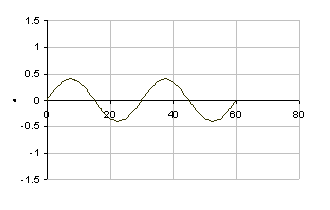
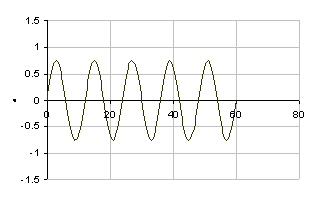
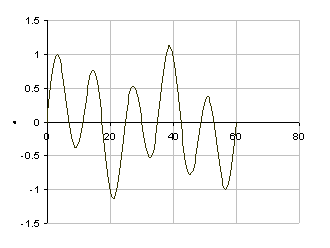
What is of particular interest is that the resulting graph is very much like the last 60 years or so of this graph (prepared by Robert A. Rohde as part of the Global Warming Art project). 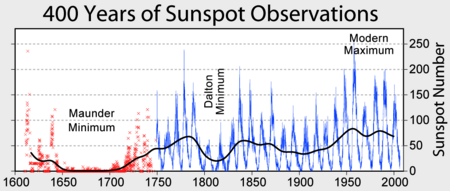
From this very basic information one might suspect that the occurrence of sunspots is connected with the orbits of Jupiter and Saturn. It also suggests that the Ancients may have had good reason to select 60 as a base for their number systems. The Duchamp response On the other hand, we have to be fun-loving. 
There are always different ways of looking at things. It only makes sense to be optimistic. Keep learning, and you keep growing. We're living at a very interesting time in history. Our ability to measure has become extremely precise. (So precise that the earth's rotation no longer serves as the best measure of time, for instance.) There's no telling how far we can go with technology. It wouldn't surprise me if we find that gravity will ultimately be found to propagate (like light, only much faster). There's a lot we could do if we worked together and stopped throwing rocks at one another. | ||||